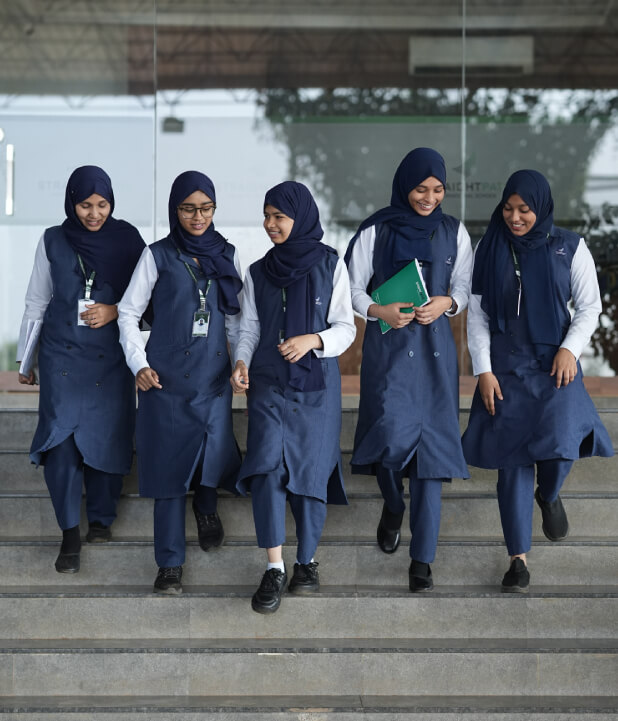
A Comprehensive Framework for Holistic Education
Designed for comprehensive learning and development
Our curriculum follows the guidelines set by the Central Board of Secondary Education (CBSE), ensuring that students receive nationally recognized education that prepares them for higher studies and competitive examinations.
We have carefully designed our curriculum to balance academic rigor with creative expression, critical thinking, and practical application. Each subject is structured to build conceptual understanding progressively across grade levels.
Our approach integrates traditional teaching methods with modern pedagogical practices, ensuring that students develop not just knowledge but also essential life skills, values, and competencies needed for success in the 21st century.
Core Subjects
Elective Options
CBSE Aligned
A balanced approach to comprehensive education
Strong foundation in core subjects including languages, mathematics, sciences, and social studies with emphasis on conceptual clarity and critical thinking.
Focus on developing life skills, communication abilities, problem-solving, creativity, and digital literacy essential for modern-day success.
Integration of moral education, cultural awareness, social responsibility, and character building into daily learning experiences.
Comprehensive coverage across all learning domains
Comprehensive study of grammar, literature, composition, and communication skills from foundational to advanced levels.
National language instruction focusing on literature, grammar, and effective communication in Hindi.
National language instruction focusing on literature, grammar, and effective communication in Arabic.
National language instruction focusing on literature, grammar, and effective communication in Malayalam.
Number systems, algebra, geometry, trigonometry, statistics, and probability with emphasis on problem-solving.
Real-world applications, data analysis, mathematical modeling for practical problem-solving.
Study of matter, energy, motion, and forces with laboratory experiments and practical applications.
Exploration of elements, compounds, reactions, and chemical processes through theory and practical work.
Life sciences covering botany, zoology, human physiology, and environmental biology with lab sessions.
Study of past civilizations, historical events, and their impact on modern society.
Physical and human geography, map reading, environmental studies, and global awareness.
Government systems, political theories, constitutional studies, and civic responsibilities.
Economic principles, market systems, national income, and global economic relations.
Financial accounting, bookkeeping, balance sheets, and financial statement analysis.
Business organization, management principles, marketing, and entrepreneurship development.
Programming, algorithms, data structures, web development, and computational thinking.
Introduction to AI, machine learning concepts, and practical applications in modern technology.
Database management, networking, web technologies, and information systems.
The subject helps to learn the duties to be done as a muslim.
The history of islam.
The learning of islam and its beliefs.
To build good characteristics as a muslim.
The verses of Allah.
What students achieve through our curriculum
Students develop deep understanding of core concepts across subjects, enabling them to apply knowledge in diverse contexts and solve complex problems effectively.
Learners acquire analytical skills to question, evaluate, and synthesize information, fostering independent thinking and informed decision-making abilities.
Students develop proficiency in expressing ideas clearly through written, oral, and digital mediums in multiple languages with confidence and clarity.
Learners become competent in using technology for learning, research, creation, and problem-solving in an increasingly digital world.
Students develop awareness of their role in society, understanding civic duties, environmental concerns, and ethical responsibilities as global citizens.
Learners cultivate curiosity, self-motivation, and learning strategies that enable them to continue growing and adapting throughout their lives.
How we deliver our curriculum effectively
Smart classrooms with digital content, interactive whiteboards, and multimedia resources make learning engaging and effective for visual, auditory, and kinesthetic learners.
Hands-on laboratory experiments, field trips, project work, and practical sessions help students connect theoretical knowledge with real-world applications.
Group projects, peer discussions, and team activities foster cooperation, communication skills, and learning from diverse perspectives.
Teachers adapt their methods to meet individual learning styles, pace, and needs, ensuring every student receives appropriate support and challenge.
Regular formative assessments, feedback, and progress monitoring help identify learning gaps and provide timely intervention for student success.
Beyond textbooks - holistic development activities
Drawing, painting, sculpture, and creative expression integrated into curriculum
Horse riding activities
Martial arts activities
Swimming activities
Footbal camp activities
Badminton activities
Skating activities
Chess activities
Comprehensive evaluation aligned with curriculum goals